SonicWorld Plugins – Telsie T v.1.0.3 AAX,VST3 x64
The SonicWorld Telsie T is a 3-band equalizer modeled after the legendary W695 equalizer from the 1970s – an iconic module known for its silky-smooth high frequencies and tight, controlled low frequencies.
Originally developed for broadcast consoles built for the German Public Broadcasters Association (ARD), the W695 was part of a new generation of solid-state technologies that defined professional audio in its day.
Along with renowned modules like the V676 microphone preamplifier, the W695 became a reliable tool in the broadcast industry.
The Telsie T accurately captures the unmistakable sonic signature that continues to make the original unit a “secret weapon” for audio engineers: smooth, refined highs and focused bass that enhance clarity without harshness.
Drawing on years of hands-on experience servicing and restoring these rare analog units, SonicWorld brings you the authentic character of the W695—without the drawbacks of older equipment like noisy switches, worn components, or hard-to-find replacement parts.
Enhanced for modern production needs, Telsie T combines vintage sound with increased reliability, flexibility, and seamless integration into modern workflows.
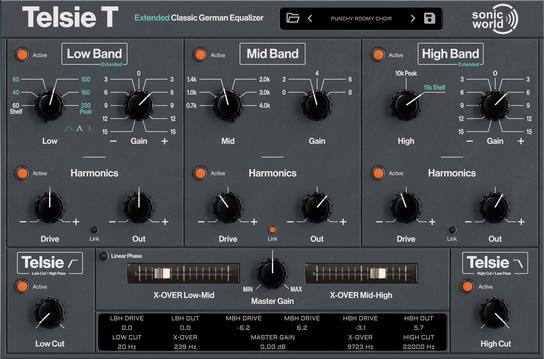
The Telsie T follows the original hardware design and features a musical 3-band equalizer with a low-pass filter and two peaking filters for precise tone adjustment. The low-frequency range provides a powerful boost of ±15 dB at 60 Hz, while the high-frequency range at 10 kHz adds smoothness, clarity, and sparkle.
A flexible midrange presence filter with six selectable frequencies makes it easy to shape clarity and sound definition.
Additional benefits of the Telsie T plugin:
Advanced bass management capabilities:
Go beyond the original design with extended bass tuning:
Additional peak filter frequencies: 40, 60, 100, 160 and 220 Hz.
Three selectable values of the Q parameter:
Wide (1 octave)
Middle (0.5 octave)
Narrow (0.25 octave)
This allows for everything from subtle tonality enhancement to precise low-frequency processing – far beyond the capabilities of the original 60Hz frequency range.
Flexible midrange presence:
The midrange acts as a powerful presence filter, performing the following functions:
Frequencies 0.7, 1, 1.4, 2, 3 and 4 kHz
Gain up to +8 dB in 2 dB steps
Ideal for adding clarity, detail and expression to any source…
Improved high-frequency signal shaping:
Classic 10kHz peaking filter for a smooth and bright range.
Additional 15 kHz high-pass filter for more airy high frequencies.
Gain up to ±15 dB in 3 dB steps
Customize everything from subtle shimmer to open, sparkling high notes.
Harmonics Function:
Each frequency band includes a separate cascade of harmonics:
Drive: Adds harmonic richness and depth to the sound.
Output: Compensates for the level of output.
Communication Switch: Controls whether the drive and output are connected.
From subtle warmth to aggressive coloration, the Telsie T delivers total control while maintaining clarity and musicality.
Low/High Pass Filter and High/Low Pass Filter:
Clean and fine-tune your signal with:
low-pass (high-pass) and high-pass (low-pass) Filters
Freely adjustable cutoff frequencies
-12dB/octave gentle slope
Ideal for eliminating boom, softening harshness and creating space in the mix.
Crossover adjustment (low/midrange and mid/high range):
In the original analog W695, the low- and high-frequency ranges have extremely wide filter curves. As a result, adjustments at 60 Hz can affect frequencies up to 2 kHz, while the peak 10 kHz band affects content starting at approximately 200 Hz.
While this broad interaction is part of the classic sound, it can also lead to unintended processing of frequency ranges that you might not want to affect.
This is where the X-Over controls come into play.
These allow you to define the crossover points at which the Telsie T’s three EQ bands interact. The default settings are 500Hz (low/midrange) and 7kHz (mid/high), providing a balanced and musical starting point while maintaining a well-defined range presence.
By adjusting these crossover points, you can change the behavior of each band in the spectrum and adapt the EQ response to different mixing situations. For example, you can narrow the low-frequency band to focus energy below 220 Hz for a more powerful vocal foundation, or reduce overlap by lowering the Low/Mid crossover frequency. Similarly, raising the Mid/High crossover frequency allows for a more precise high-frequency boost without overly affecting the lower midrange.
This level of control makes it much easier to achieve targeted, conscious results in the area of emotional intelligence across a wide range of sources.
We recommend checking out the included presets to quickly appreciate the full power of this feature.
The Telsie T uses a carefully designed nonlinear
filtering circuit for the crossover network, chosen for its musical and natural sound. However, in multichannel systems, such as when recording drums, this design can cause phase interactions between channels.
To address this issue, Telsie T includes a Linear Phase mode, which provides an alternative filter behavior with a more linear phase response. This helps maintain phase consistency in complex multi-microphone recordings and delivers a more transparent and controlled stereo image.
With linear phase activation, the low-pass and high-pass filters are automatically disabled to maintain the integrity of phase-aligned processing.
This mode is ideal when maximum accuracy and phase stability are required, while Standard mode remains the preferred choice for musical, analog sound.
Gain control and parameters panel :
The Master Gain control is used to compensate for any level changes caused by EQ or harmonic saturation. It ensures a stable output signal level during sound shaping. Pressing the control instantly resets it to 0 dB for quick A/B comparisons.
The parameters panel provides a visual overview of all key settings. It displays the current harmonic stage values for each band—LBH (low-band harmonics), MBH (mid-band harmonics), and HBH (high-band harmonics), as well as the Low Cut and High Cut filter positions, both crossover frequencies, and the overall gain level.
This ensures complete transparency and precise control over the entire signal path at all times.